Lipid Profile Interpretation & Management™ · A4 PDF
Understand lipid profiles with greater clarity
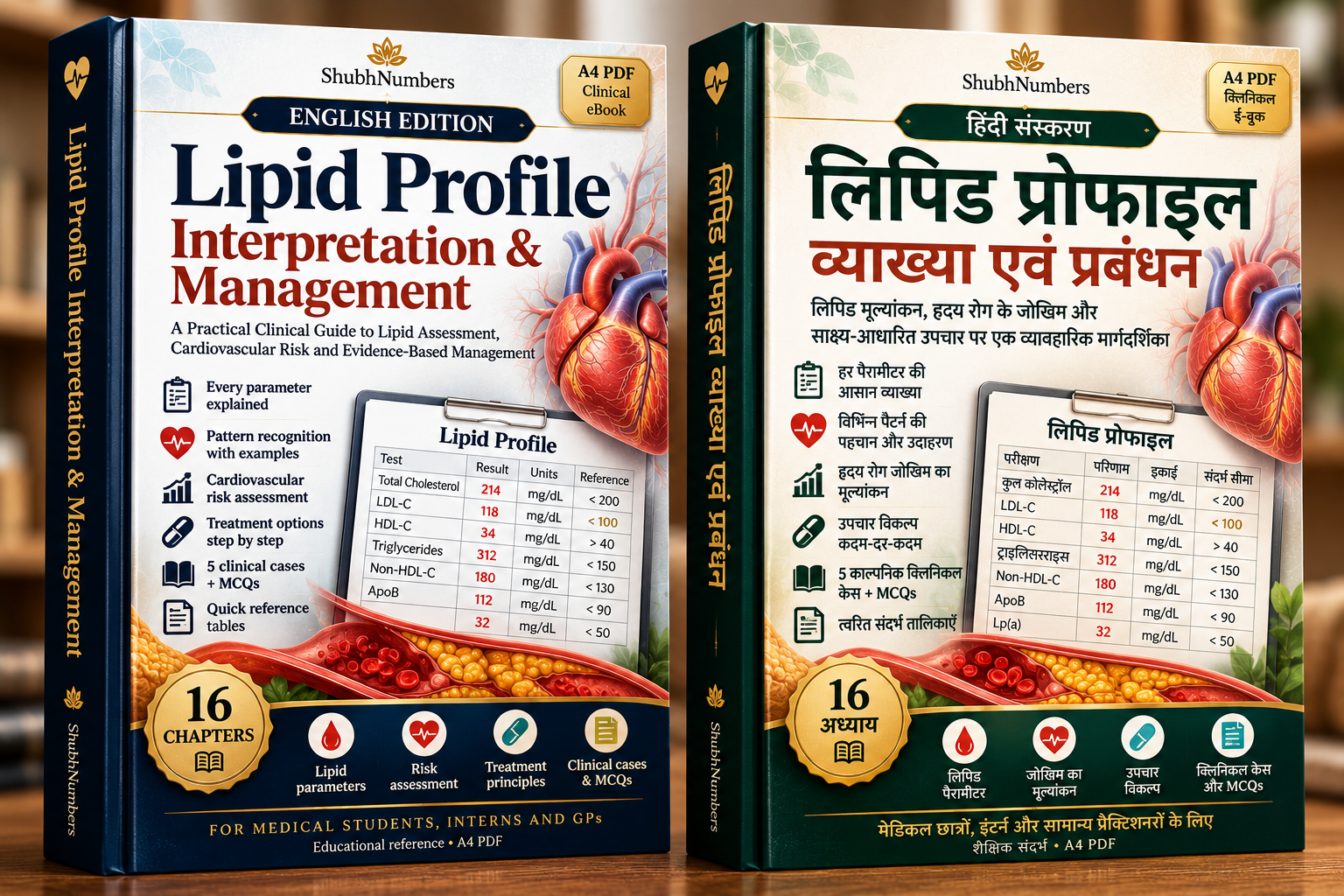
A Practical Clinical Guide to Lipid Assessment, Cardiovascular Risk & Evidence-Based Management — for medical students, interns and GPs.
The report is easy to read. Interpreting it isn't.
Is a calculated LDL-C valid when triglycerides are 450? Does a low HDL-C need its own treatment? When does a number point to familial hypercholesterolaemia instead of diet?
Students often memorise cut-offs without the reasoning that connects LDL-C, HDL-C, non-HDL-C, cardiovascular risk and secondary causes. This book builds that reasoning step by step.
What's included
Every parameter explained
TC, LDL-C, HDL-C, TG, non-HDL-C, ApoB and Lp(a) — what each measures and its limits.
Pattern recognition
Isolated, mixed, atherogenic and type III patterns side by side.
Risk assessment
Risk categories, enhancers and why South Asian risk is often underestimated.
Treatment principles
Statin intensity, ezetimibe, PCSK9-directed therapy, fibrates and omega-3.
5 fictional cases
FH, diabetes, severe TG, hypothyroidism and post-MI escalation.
MCQs + explanations
Self-test questions with the reasoning behind each answer.
Table of contents
- 01Lipoprotein transport
- 02The standard lipid profile
- 03LDL-C: the primary causal target
- 04HDL-C: marker, not target
- 05Triglycerides & TG-rich lipoproteins
- 06Non-HDL-C, ApoB and Lp(a)
- 07Dyslipidaemia patterns
- 08Secondary causes
- 09Cardiovascular risk assessment
- 10Lifestyle foundations
- 11Statin therapy
- 12Non-statin therapies
- 13Clinical decision pathways
- 14Fictional clinical cases
- 15MCQs with explanations
- 16Quick reference tables
Inside the eBook
Chapter 7 · Pattern table
| Pattern | LDL-C | TG | HDL-C |
|---|---|---|---|
| Isolated high LDL | ↑ | N | N |
| Mixed | ↑ | ↑ | N/↓ |
| Atherogenic | N/↑ | ↑ | ↓ |
| Isolated high TG | N | ↑ | ↓ |
| Type III | Unreliable | ↑ | N |
Chapter 13 · Decision pathway
- 1Validate the result — fasting, acute illness, method
- 2Identify the pattern and any severe values
- 3Exclude secondary causes (TSH, HbA1c, eGFR, LFTs)
- 4Assign cardiovascular risk category
- 5Lifestyle for all; statin intensity matched to risk
- 6Recheck in 4–12 weeks and escalate to goal
- 7Refer: suspected FH, severe TG, intolerance
Chapter 14 · Fictional case
A 52-year-old woman with type 2 diabetes: TC 214, HDL-C 34, TG 312, LDL-C (Friedewald) 118 mg/dL. Non-HDL-C is 180 mg/dL. Interpretation: atherogenic dyslipidaemia — non-HDL-C and ApoB reflect risk better than LDL-C alone.
Choose your edition
English Edition
Lipid Profile Interpretation & Management™
A Practical Clinical Guide to Lipid Assessment, Cardiovascular Risk & Evidence-Based Management
Educational reference · A4 PDF
Lipid Profile Interpretation & Management™ — English Edition
A practical medical education eBook covering lipid parameters, interpretation patterns, cardiovascular risk, common secondary causes, treatment principles, clinical cases, revision questions and reference material.
Hindi Edition
Lipid Profile Interpretation & Management™
A Practical Clinical Guide to Lipid Assessment, Cardiovascular Risk & Evidence-Based Management
Educational reference · A4 PDF
Lipid Profile Interpretation & Management™ — Hindi Edition
A separate, easy-to-understand Hindi medical guide explaining lipid profile interpretation and management concepts, keeping standard English medical terminology.
English + Hindi
Lipid Profile Interpretation & Management™
A Practical Clinical Guide to Lipid Assessment, Cardiovascular Risk & Evidence-Based Management
Educational reference · A4 PDF
Lipid Profile Interpretation & Management™ — English + Hindi Bundle
Get both editions together — the complete English eBook and the Hindi eBook.
FAQs
Start your lipid profile revision today
- 16 chapters
- PDF delivered on WhatsApp & email
- English or Hindi